The Vinegar Line: Five Kirkbymoorside Loops Timed for the Fryer's Last Hour
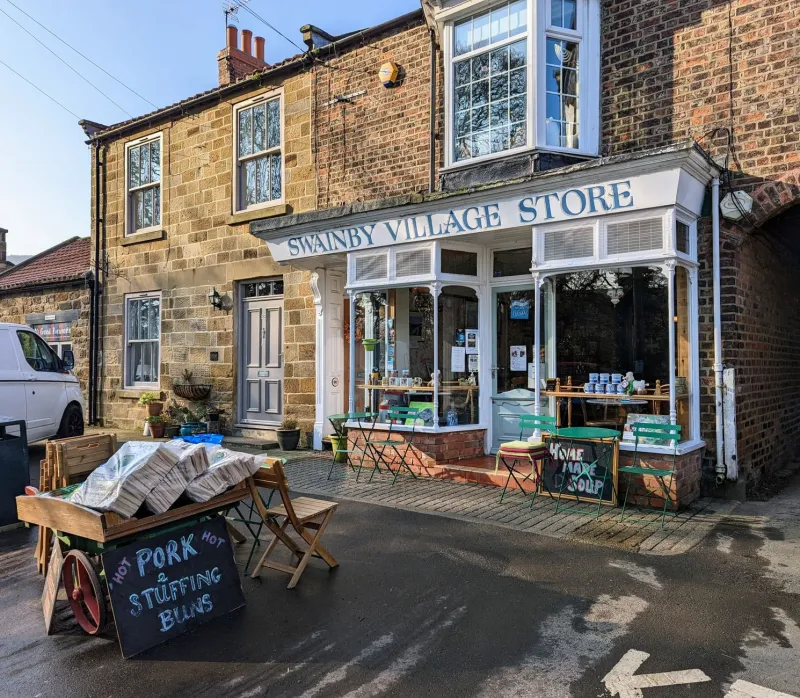
There is a particular kind of walk that ends with salt on your fingers and paper unfolding on your knees. It is not a summit walk, and it is not a picnic walk either. It is a walk with a deadline attached — the sort of deadline that has a queue in front of it and a chalkboard behind it.
Kirkbymoorside is well suited to this. The town sits at the foot of the moor with lanes going up, a river going quietly along the bottom, and a chip shop sitting more or less between the two. The five routes below all start and finish on or near the square. Each one is planned backwards from the moment you push the door open, so the arithmetic matters as much as the map.
A word before you set off: the fryer keeps lunchtime and evening hours and takes a rest day early in the week. Check the door, or the window notice, before you commit to a route. A sunset loop is a lovely idea until you are standing outside a dark shop with wet boots and high hopes.
1. Kirkdale and Cauklass Bank — four miles, about an hour and three-quarters
The classic. Out along the river path towards Kirkdale, then a short pull up Cauklass Bank before dropping back into town. It is the best first route because it gives you a bit of everything: water, trees, a churchyard, a view over the rooftops, and just enough climbing to justify the walk but not enough to make you regret it.
The path along the beck can be muddy after a wet week and the low sections hold water. If the river is up and noisy, turn it into an out-and-back on the higher field edge instead and skip the bank entirely — you lose the view, you keep the dinner.
Give yourself twenty minutes at the far end. Rushing the good bit to save time for chips is a false economy.
2. Gillamoor and the top road — five and a half miles, roughly two and a half hours
Up to Gillamoor on the lanes, back along the higher ground with the vale opening out to your left. This one has the best light of the five if you time it for late afternoon, because the sun drops behind you and the field patterns go gold and shadowed at the same moment.
Terrain is a mix of tarmac, field edge and stone track. The lanes are quiet but not empty, and there is no pavement for stretches, so walk facing the traffic and keep the dog close. In hill fog the top road loses its point — the whole appeal is the view — so save this one for a clear-ish day and use route three when the cloud is sitting low.
3. Hagg Wood and the Vivers path — two and a half miles, an hour if you dawdle
The wet-weather route, and honestly the one most likely to be walked twice in a week. Trees, shelter, mud that is at least honest mud, and a loop short enough to fit between a late afternoon and an early tea.
This is the route for the days when the moor has vanished into grey and the forecast is threatening worse. Waterproof boots, no great ambitions, and back in town before the rain really settles in. It also works beautifully in autumn when the leaves are down and the paths turn copper.
If you have an hour to kill and no appetite for a climb, take this one and add an extra half-mile wander along the beck at the end. It stretches the legs without stretching the schedule.
4. Fadmoor fields — three and a half miles, around ninety minutes
Quiet field paths and lanes out to Fadmoor and back, with long views and very little company. There is something oddly satisfying about a walk where the main event is a gate, a stile, and a field of sheep doing nothing in particular.
This one drains well and suits spring and early summer, when the hedges are doing their thing. In deep winter the field sections can be heavy going and the stiles slippery, so treat timings as optimistic and add fifteen minutes.
Good for a lunchtime run at it, when the shop is quieter and you can eat sitting down rather than standing about.
5. Lastingham and Spaunton Bank — six and a half miles, three hours plus
The long one, and the only route here that really asks anything of you. Out to Lastingham, a climb onto the bank, and a return through Spaunton with the moor edge on one side and the vale on the other. Do it on a long June evening or a crisp, still afternoon in early autumn.
Exposed on the top, so take a layer you can put on without stopping. In wind and rain, cut it short and bank the extra miles for another day — this is a route that rewards patience and punishes bravado.
Because it is longer, the timing is tighter. Leave with three clear hours in hand, and if you are going to be late, be late by ten minutes rather than forty. The queue does not care about your Strava.
The etiquette of bench chips
There are rules, unspoken but real.
Salt before you sit, not after. Vinegar on the chips, never on the seat. Open the paper wide across your knees so the wind does not redistribute your dinner along the pavement. If the light is going, find a bench facing west and let the last of it do the work.
Do not feed the gulls. Do not feed anyone else's dog without asking, however persuasive the dog. And when you are done, fold the paper, find the bin, and leave the bench as you found it — this is a small town and the benches are shared property.
Eat them hot. That is really the whole of it. Chips are a timing exercise same as the walk, and a chip that has gone cold on a bench in the name of good conversation is a chip wasted.
Practical notes
Boots for routes one, three and five; decent trainers will do for two and four in dry weather. Carry a torch from October onwards — the lanes out of town go properly dark. Take a fiver in change even if you plan to pay by card, because small shops are small shops. And if you arrive to find a queue out the door, that is not a problem. That is the walk working exactly as intended.