The Sheep-Keeper's Map: A Pinfold Circuit from Kirkbymoorside
Photo: drystone wall pinfold North York Moors sheep village, via www.statisticalaid.com
Pinfolds are easy to miss. They sit at the edge of villages like small, stubborn stone rooms with no roof and no obvious purpose, and most of us walk past them on the way to somewhere else. But once you start looking, they become the sharpest clue to how the moor was actually worked: not by lone shepherds with crooks, but by whole townships gathering sheep into one shared pen when the rule book said so.
This route takes you out of Kirkbymoorside on a half-day circuit of about six and a half miles, heading west through Keldholme and up to Gillamoor, then looping back through Fadmoor. It is not a big day out. It is a slow one, with time built in for peering over walls, reading gateposts, and wondering why a hedge bends where it does. Bring the OS Explorer OL26 if you like a paper map, though the waymarks are good enough for most of it.
Out of the square and down to the beck
Start on Kirkbymoorside's Market Place, where the wide cobbled space still feels like a place meant for animals as much as people. Head west along West End, past the last of the shopfronts, and pick up the footpath sign for Keldholme just before the road begins to feel properly rural. The path drops gently through trees to the beck, and this is your first lesson in local geography: the town sits on a shelf, and the water does the engineering below it.
Cross the beck and follow the track as it curls right, then left, climbing between hedges towards the lane. In late autumn the hedge bottoms are full of old man's beard and the smell of wet bark. Turn right on the lane and follow it north-east to Gillamoor, keeping an eye on the field boundaries to your left. The walls here are not decorative. They are a working ledger of who held which land and when the sheep moved.
A pen with a job to do
Gillamoor's pinfold sits quietly near the village edge, a stone enclosure that once held stray animals until their owner paid a fine. That is the official story, and it is true enough. But pinfolds were also communal kit: places to hold sheep during gatherings, sorting, clipping, or dosing, when every hand in the township was needed and no single farm could manage alone. The name itself comes from 'pind' or 'pen' plus 'fold' — a place to fold animals in.
Stand at the gate for a minute and the shape starts to make sense. Many pinfolds are roughly circular or have rounded corners, which is not just aesthetic. Sheep move better in curves than in sharp angles, and a rounded pen is easier to work without a crush of bodies in a corner. The walls are thick, the gate is narrow, and the whole thing is scaled to a person on foot with a stick and a dog, not to a tractor.
Reading the walls like a ledger
From Gillamoor, take the footpath north towards Fadmoor. This is the best stretch for landscape clues, so walk it slowly.
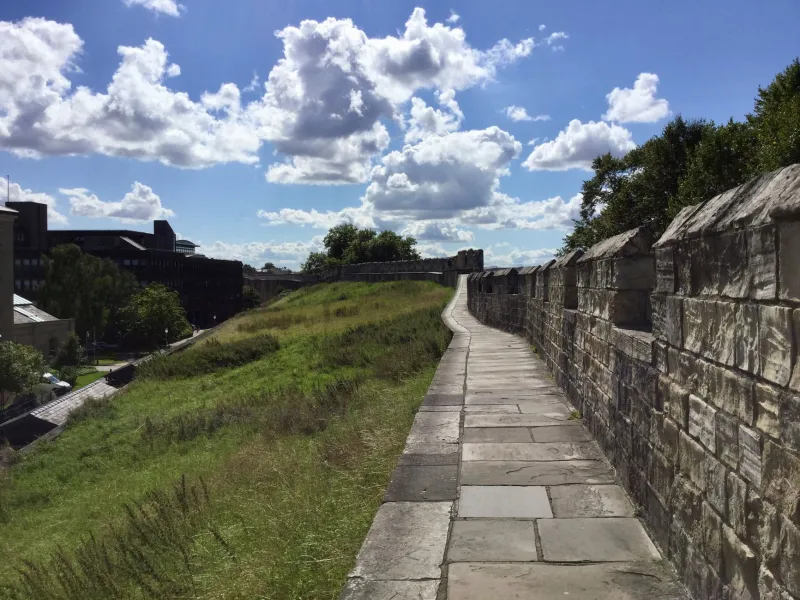
Look for throughstones — the long flat stones set across the wall to tie the two faces together. Look for the coping stones on top, set upright or slightly angled, which shed water and stop the wall from dissolving. Look, too, for small square gaps at the base: sheep creeps, or smoots, designed to let sheep through while keeping larger beasts out. A wall with a creep is a wall that expects traffic.
Hedges tell a similar story. A laid hedge, with its stems partly cut and folded sideways, is a boundary that was meant to last. You can often see the pleachers — the living stems that were bent rather than cut through — and the hazel or willow binders holding the top down. A hedge that has been laid recently looks brutal for a season and then thickens into something stock-proof and full of birds.
And then there are the holloways. The path between Gillamoor and Fadmoor drops into a sunken lane for a stretch, worn down by feet, hooves and water. These are the moor's oldest roads, and they are a reminder that before tarmac and satnav, the shortest route was often the one that had already been walked.
The pub stop
Fadmoor is small, but it has a pub, and the Plough is a sensible target for a late lunch or an early pint. If you are walking on a Sunday, check hours before you set out; moorland pubs keep their own clocks. The Royal Oak at Gillamoor is another option if you want to stop earlier in the route, and it makes a good halfway house if the weather is turning.
This is not a route for a rushed sandwich. Sit down. Take your boots off if the pub allows it. The point of a pinfold walk is to notice how much of the landscape was built for collective work, and a pint in a village that still runs on a handful of farms is part of the same lesson.
The return leg
From Fadmoor, pick up the lane and footpaths heading south-east back towards Kirkbymoorside. The route crosses fields and a couple of small becks, then joins the lane near Keldholme again. If you have time, take the slightly longer way back through the fields rather than the road; the views back to the town are better, and you get one last look at the wall lines running up towards the moor.
As you come back into Kirkbymoorside, notice how the town itself is part of the same system. The wide market square, the old yards behind the front streets, the lanes that lead out to the fields — all of it was built to handle animals, wool, and the business of a moorland town. The pinfolds are just the smallest, plainest rooms in that bigger house.
Practical bits
Distance: about 6.5 miles, with a few short climbs. Allow three to four hours, more with a pub stop. Terrain: field paths, lanes, and short sections of road; expect mud after rain. Map: OS Explorer OL26. Buses: the 128 serves Kirkbymoorside from Helmsley and Pickering, so it is possible without a car. Dogs: keep them on leads around livestock, especially in spring. Best time: late spring for hedges in leaf, or autumn for clear views and quiet pubs.
One last thing: do not climb into the pinfolds. They are old, they are fragile, and they are still the best teachers we have for how this landscape was shared.