No Car, No Problem: Three Moorland Walks That Begin at a Kirkbymoorside Bus Stop
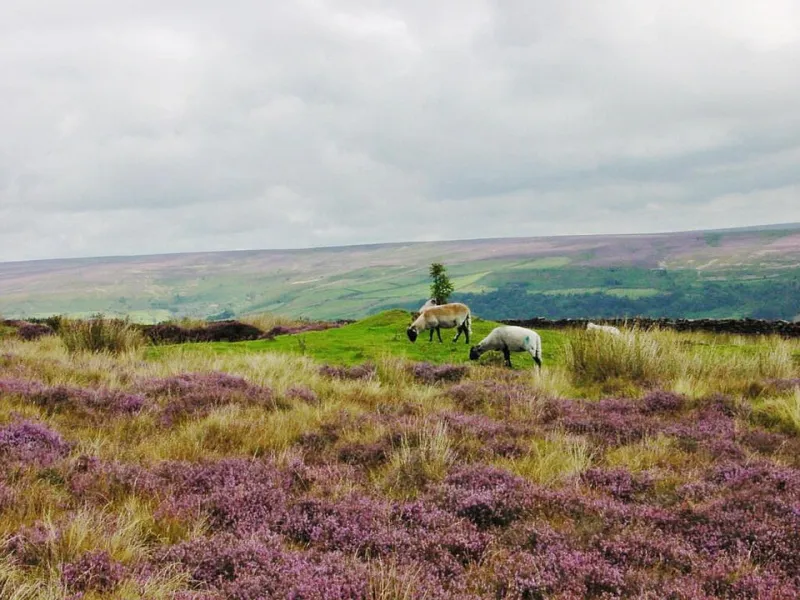
Photo: oeuvre personnelle/own work, CC BY-SA 2.5, via Wikimedia Commons
There's a particular kind of smugness available to the walker who steps off a bus at the edge of the moor. No parking row, no worrying about whether the handbrake will hold on a 1-in-4, no arguing about whose turn it is to drive home. Just boots on, rucksack up, and a pint waiting at the other end.
The North York Moors are genuinely reachable by public transport. Kirkbymoorside sits on a useful web of services: a year-round bus linking it with Helmsley and Pickering, and the seasonal Moorsbus network that opens up the villages and moorland edges on Sundays and bank holidays through the warmer months. The exact timetables change every season, so treat what follows as a shape for the day rather than gospel — check the current Moorsbus and North Yorkshire travel information before you travel, especially in autumn 2026 when the winter timetable kicks in.
One golden rule: buses here are not frequent, and the last one of the day leaves early. Plan your walk around the return bus, not the other way round.
Walk 1: Gillamoor and Back — The Gentle One
Distance: roughly 5 miles (8 km) | Time: 2.5–3 hours | Terrain: field paths, stiles, one steady climb
Start from the town centre and head north out of Kirkbymoorside on the lane towards Gillamoor. The path climbs gently, then more than gently, up through farmland onto the ridge — and the payoff comes just before the village, where the view opens out across the dale. Gillamoor's famous viewpoint is worth the last few hundred yards even if you're not remotely religious about vistas.
Drop into the village, have a look at the church, and consider a stop at the pub if it's open — it's the sort of place where a passing trade is warmly received and the sandwiches are unfussy. Then either retrace your steps or make a loop of it on the lanes, depending on how much mud you're prepared to negotiate.
This is the walk to choose if you're with someone who "doesn't really do walking". It's short, the rewards are immediate, and the climb is over before anyone has time to complain properly.
Walk 2: Hutton-le-Hole via Lastingham — The Proper Day Out
Distance: about 7 miles (11 km) | Time: 3.5–4.5 hours | Terrain: field paths, woodland, some road walking, several stiles
Head west out of Kirkbymoorside and work your way through the lanes and field paths towards Lastingham. The village is small and slightly magical, tucked into a fold of the hills, and its church crypt is genuinely one of the strangest and oldest spaces in the moors — cool, dark, and full of the sense that people have been coming down those steps for a very long time.
From Lastingham, a short hop over the fields brings you to Hutton-le-Hole, where a beck runs straight down the middle of the village green and the folk museum occupies a cluster of old buildings. This is the best lunch stop on the list: a pub, a café, and a bench by the water all compete for your custom.
Return the same way, or shorten the day by catching a bus back if the timings work in your favour. If you've never done it, walking a section of the return leg on the road with the moors on your left and the vale falling away on your right is a fine way to spend an afternoon.
Walk 3: The Bus-Assisted Ridge — The Clever One
Distance: about 4 miles (6.5 km), one way | Time: 2 hours of walking | Terrain: moorland edge paths, uneven in places, boggy after rain
This one is the whole point of the article. Take the bus up the vale towards the moor — the seasonal services will get you to one of the villages on the ridge — and then simply walk back down to Kirkbymoorside. You start high, you finish at a pub, and you never once have to climb the hill at the end of a long day.
The route down is mostly on quiet lanes and footpaths, with long views over the dale and a strong sense of having got away with something. Take an OS Explorer map (OL26 covers the western moors) and don't rely on a phone signal, because there largely isn't one up there. Sections get properly squelchy after rain — gaiters are not an affectation on this one.
The joy of a linear walk is that you notice things you'd otherwise march past. A barn. A gate with a name on it. The exact point where the moor stops being moor and starts being farmland. Coming down into town with the square ahead of you is a satisfying way to finish.
Bus Basics and Kit Notes
- Check before you go. Seasonal services run on Sundays and bank holidays, usually from spring to late autumn. Winter services are thinner. The current timetables are published online and at stops in town.
- Day tickets are usually the best value if you're making more than one journey, and some allow travel across the wider network.
- The last bus is the plan. Work backwards from it. Nobody wants to be the walker ringing a taxi from a village with one street.
- Bring cash and a card, plus water — there are no shops on the ridge.
- Dogs are welcome on most of these paths, but there's livestock about, so leads and short tethers are the order of the day. Check any seasonal restrictions on the open moor.
- Boots, not trainers. It's a cliché because it's true.
The Point of It
The moors are not a theme park bolted onto a car park. They're a landscape with villages, farms and timetables, and arriving by bus puts you inside all of that rather than looking in from behind a windscreen. You'll see the same hills. You'll just enjoy them more, and you'll have a pint at the end without a single anxious thought about the drive home.